Artan
Azalan
Ýþlem
BIST 30
BIST 50
BIST 100
NASDAQ 100
Hisse Fiyat Fark% Hacim (TL) Düþük / Yüksek
119,90 10% 1,03 Mr 110,30 / 119,90
34,80 9.99% 87,55 Mn 34,80 / 34,80
85,95 9.98% 218,93 Mn 76,30 / 85,95
6,39 9.98% 502,56 Mn 6,02 / 6,39
13,12 9.97% 4,81 Mr 11,64 / 13,12
Hisse Fiyat Fark% Hacim (TL) Düþük / Yüksek
2,90 -9.94% 876,90 Mn 2,90 / 3,13
7,80 -8.24% 5,48 Mn 7,80 / 8,01
1.377,00 -8.08% 124,92 Mn 1.357,00 / 1.508,00
6,60 -7.17% 73,09 Mn 6,55 / 6,88
22,06 -7.15% 212,09 Mn 22,06 / 24,44
Hisse Fiyat Fark% Hacim (TL) Düþük / Yüksek
3,29 7.52% 16,68 Mr 3,06 / 3,32
321,25 1.26% 6,68 Mr 317,75 / 322,25
13,12 9.97% 4,81 Mr 11,64 / 13,12
411,25 0.06% 3,52 Mr 407,00 / 416,25
23,88 6.13% 3,41 Mr 22,36 / 24,18
Hisse Fiyat Fark% Hacim (TL) Düþük / Yüksek
18,42 -0.86% 353,92 Mn 18,38 / 18,66
77,70 -0.51% 2,56 Mr 77,40 / 78,50
411,25 0.06% 3,52 Mr 407,00 / 416,25
191,20 -0.42% 2,48 Mr 189,40 / 193,10
744,00 -0.27% 1,20 Mr 743,00 / 752,00
Hisse Fiyat Fark% Hacim (TL) Düþük / Yüksek
18,42 -0.86% 353,92 Mn 18,38 / 18,66
77,70 -0.51% 2,56 Mr 77,40 / 78,50
93,35 0.16% 192,17 Mn 92,75 / 94,05
115,60 -0.34% 86,18 Mn 114,90 / 116,30
411,25 0.06% 3,52 Mr 407,00 / 416,25
Hisse Fiyat Fark% Hacim (TL) Düþük / Yüksek
18,42 -0.86% 353,92 Mn 18,38 / 18,66
31,02 0.65% 86,23 Mn 30,62 / 31,62
77,70 -0.51% 2,56 Mr 77,40 / 78,50
10,78 0.75% 94,04 Mn 10,71 / 10,82
82,60 1.47% 173,86 Mn 81,35 / 82,95

Masrafsýz Bankacýlýk + 1.000 TL Nakit! Enpara’dan Çifte Avantaj

Masrafsýz Bankacýlýk + 1.000 TL Nakit! Enpara’dan Çifte Avantaj
Sayfa 282/1006 ÝlkÝlk ... 182232272280281282283284292332382782 ... SonSon
Arama sonucu : 8043 madde; 2,249 - 2,256 arasý.

Konu: Vob 24

  1. #2249
    Millet maç tartýþýrken etrafýmýzda neler oluyor diye þöyle bir baktým.

    ABD Suriye güçlerine karþý savaþmalarý için IÞÝD'e istihbarat ve lojistik destek vermeye baþlamýþ. (Ortadoðu'yu iþgal etmek için IÞÝD'i yaratan ABD artýk sonuca ulaþmak için yapacaðýný açýkça yapmaya baþlamýþ).

    Yine ABD, Türkiye Ýran sýnýrýna yaklaþýk 10000 asker yýðmýþ. Barzani'nin referandumuna yarým aðýzla karþý çýkýyormuþ gibi yapan ABD açýkça Barzani ve Kürdistan'a destek vermeye baþlamýþ.

    Merak ediyorum. Bu ülke insanýnýn ne kadarý bu olaylarýn gelecekte bu ülkeyi ne hale getireceðini düþünüyor, tartýþýyor, Arda'nýn oyundan çýkarken sýrýtmasýný tartýþtýðý kadar (izlemedim, Twitter'da okudum).

    Her geçen gün umudum iyice azalýyor.

    Lenovo P1a42 cihazýmdan hisse.net mobile app kullanarak gönderildi.

  2.  Alýntý Originally Posted by JAS Yazýyý Oku
    Sene 1991 ya da 1992. Futbolun insanlarý nasýl insanlýktan çýkarýp, garip yaratýklar haline soktuðunu gördüðüm zaman futboldan nefret etmiþtim. O günden beri maç izlemem.

    Bir emekçinin ömrü boyunca görmediði parayý bir günde alan ve topa vurmaktan baþka bildiði olmayan bu adamlarýn, gerçek sanatçýlardan, yazarlardan, bilim insanlarýndan üstün tutulmalarý kanýma dokunur.

    Bu düþüncem, kýytýrýk dizilerde rol alarak, TV programlarýnda þakrabanlýk yaparak, bir podyumda 5-10 dakika giysi göstererek, ya da 1-2 þarký söyleyerek bir çalýþanýn hayalini bile göremeyecek paralarý kazananlar için de gerekli.

    Demem o ki, bu tip insanlarý ilahlaþtýrdýðýmýz sürece, hak etmedikleri parayý kazanmalarýna sebep olduðumuz sürece bu saçmalýk devam edecek.

    Maniki Dünya.

    Lenovo P1a42 cihazýmdan hisse.net mobile app kullanarak gönderildi.
    Alýn benden de o kadar.

  3. #2251
    Sakýn kimse maçýn milli maç olduðundan falan bahsetmesin. Çýkacaklarý bir milli maç öncesi, maç yerine alacaklarý primi konuþan ve prim yeterli gelmeyince oynamak istemeyenlerin oluþturduðu bir takým milli falan olmaz.

    Tüm kavramlarýn içlerini boþaltmakta üstümüze yok. Yýllar öncesi yine bir Ýzlanda- Türkiye maçý. Spiker anlatýyor, Ýzlanda takýmýnýn tamamýnýn maliyeti, bizim bir oyuncunun maliyetine eþit.
    Adamlarýn meslekleri, balýkçý, marangoz, vs vs.

    Sonuç mu. O maçta da yenilmiþtik.

    Pehhh.

    Lenovo P1a42 cihazýmdan hisse.net mobile app kullanarak gönderildi.

  4. #2252


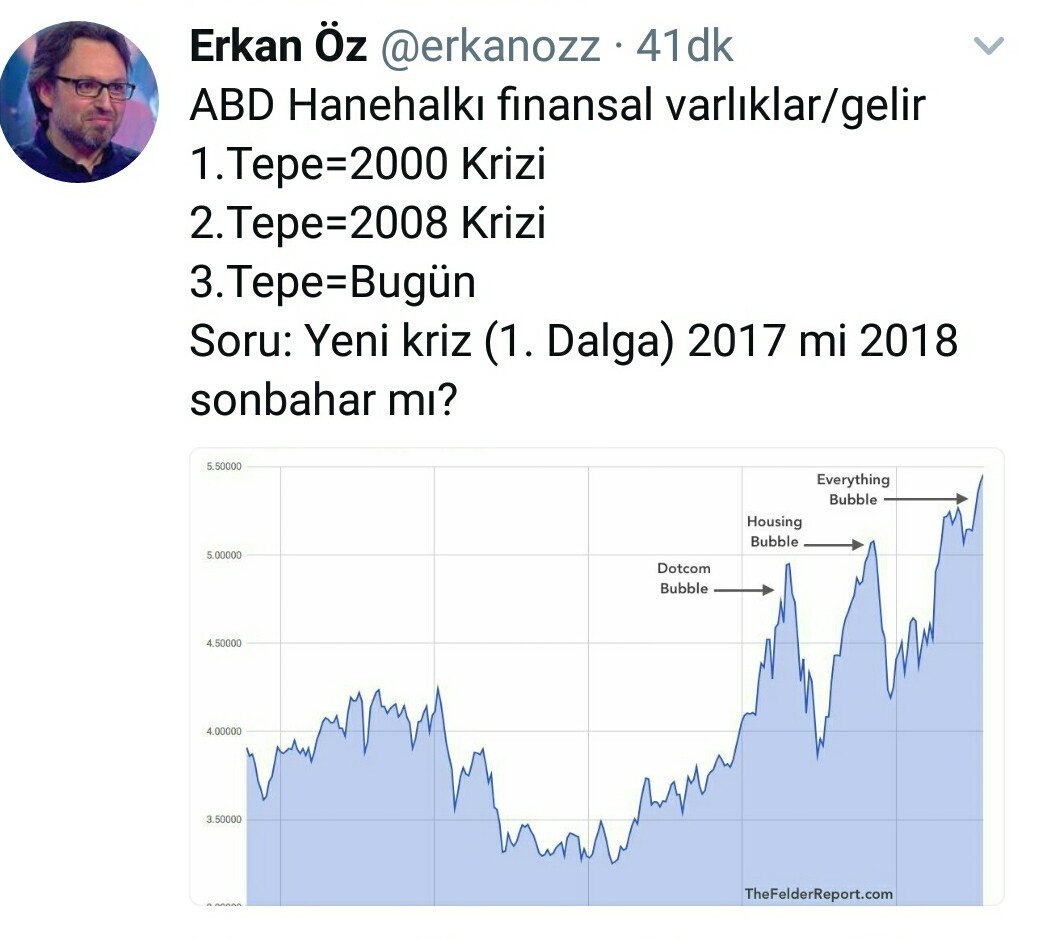
    Ekonomiye gelirsek, yukarýdaki resim yoruma gerek yok diyor. Büyük bir cisim yaklaþýyor. Sermayenin ciddi anlamda el deðiþtireceði çok berbat bir dönem adým adým yaklaþýyor.

    Lenovo P1a42 cihazýmdan hisse.net mobile app kullanarak gönderildi.

  5. #2253
    dün bu ülkede olmayan bir þey oldu ilk darbe balýkesirden 2 darbe ankaradan geldi artýk yeter dendi devamý tabiki gelecektir siyaset borsayý etkiler aman dikkat

  6. #2254
    https://www.cnbc.com/2017/10/05/curr...-in-focus.html

    Dollar drops on North Korea fears, offsetting wage data boost
    Fears rise of North Korea missiles after news report


    Wage data lifts chances of December rate hike by Fed


    Dün ABD 10 yýllýk tahvillerinin %2.40 dan dönmesi ve sonrasýnda dolar endeksinin deðer kaybetmesinin sebebi Kuzey Kore'nin yeni bir uzun menzilli füze denemesine hazýrlandýðý haberiyle oldu.Haber asýlsýz çýkarsa tahvil faizlerinin ve dolar endeksinin deðer kazanmaya devam etmesi muhtemel gözüküyor.

  7.  Alýntý Originally Posted by JAS Yazýyý Oku
    Sene 1991 ya da 1992. Futbolun insanlarý nasýl insanlýktan çýkarýp, garip yaratýklar haline soktuðunu gördüðüm zaman futboldan nefret etmiþtim. O günden beri maç izlemem.

    Bir emekçinin ömrü boyunca görmediði parayý bir günde alan ve topa vurmaktan baþka bildiði olmayan bu adamlarýn, gerçek sanatçýlardan, yazarlardan, bilim insanlarýndan üstün tutulmalarý kanýma dokunur.

    Bu düþüncem, kýytýrýk dizilerde rol alarak, TV programlarýnda þakrabanlýk yaparak, bir podyumda 5-10 dakika giysi göstererek, ya da 1-2 þarký söyleyerek bir çalýþanýn hayalini bile göremeyecek paralarý kazananlar için de gerekli.

    Demem o ki, bu tip insanlarý ilahlaþtýrdýðýmýz sürece, hak etmedikleri parayý kazanmalarýna sebep olduðumuz sürece bu saçmalýk devam edecek.

    Maniki Dünya.

    Lenovo P1a42 cihazýmdan hisse.net mobile app kullanarak gönderildi.
    Aynen öyle......

  8. #2256
    TÜRKÝYE EKONOMÝSÝNÝN GÖRÜNÜMÜ(EKÝM 2017)

    1)GSYÝH: %5.1 (2017 2.çeyrek)
    ( Y.T :Tuik 11.09.2017)

    2)ENFLASYON: %11.20 (yýllýk,Eylül 2017 sonu itibariyle)
    ( Y.T :Tuik 03.10.2017)

    3) TARIM DIÞI ÝÞSÝZLÝK ORANI:%13.2 (Haziran 2017 sonu itibariyle)
    ( Y.T :Tuik 15.09.2017)

    4)Yýlýn ilk 9 ayýndaki DIÞ TÝCARET AÇIÐI: %27.79 artýþla 53.800 milyar dolar.

    5)BÜTÇE AÇIÐI:Geçen yýl 29.932 milyar tl iken bu sene OVP'de %106 artýþla 61.700 milyar tl olarak planlanmýþ ancak yýl sonuna kadar alýnan net borçlanma yetkisinin 83.9 milyar tl ye çýkarýlma talebi bütçe açýðýnýn OVP da öngörülenin daha da üzerine çýkacaðýný gösteriyor.

    6)BORÇ ÝSTATÝSTÝKLERÝ
    (T.C.Merkez Bankasý ve Hazine Müsteþarlýðý)

    I-ULUSLARARASI YATIRIM POZÝSYONU(Y.T:21.09.2017)
    (Milyar ABD Dolarý)


    Varlýklar: 221.026

    Yükümlülükler: 670.907

    Uluslararasý Yatýrým Pozisyonu, net: -449.881


    II-KALAN VADEYE GÖRE BORÇLU BAZINDA KISA VADELÝ DIÞ BORÇ STOKU (*) (Temmuz 2017 itibarýyla) (Milyar ABD Dolarý) (Y.T:20.09.2017)


    KALAN VADEYE GÖRE KISA VADELÝ DIÞ BORÇ STOKU (*)
    (Temmuz 2017 itibarýyla)
    (Milyar ABD Dolarý)


    MERKEZ BANKASI :0.791

    GENEL YÖNETÝM (**): 6.341

    BANKALAR:94.375

    DÝÐER SEKTÖRLER: 68.951

    TOPLAM 170.548


    (*) Orijinal vadesine bakýlmaksýzýn vadesine bir yýl ve daha kýsa kalan dýþ borçlarý göstermektedir. (**) Hazine Müsteþarlýðý tarafýndan yurtdýþýnda ihraç edilen borçlanma senetlerinden (eurobond) itfasýna bir yýl ve daha kýsa vade kalanlar için yapýlacak ödemeleri kapsamaktadýr (yurtiçi yerleþik kiþilerce satýn alýnanlar hariç).

    III-TÜRKÝYENÝN DIÞ BORCU (Y.T:29.09.2017)
    (Milyar dolar)(2017/2 çeyrek sonu itibarýyla)(Hazine Müsteþarlýðý)

    T.C.M.B:0.806
    KAMU:129.348
    ÖZEL SEKTÖR:302.198

    TOPLAM:432.352

    V-T.C.MERKEZ BANKASI REZERVLERÝ(29.9.2017 ÝTÝBARIYLA)
    (Milyar dolar)

    (Altýn hariç)Brüt:91.503 milyar dolar

    NET:30 Milyar dolar civarý.


    TOPLAM:432.352

    IV-CARÝ AÇIK(15.09.2017 ITIBARIYLA)

    37.112 milyar dolar(2017 Temmuz sonu itibariyle yýllýk)


    SONUÇ:Tabloya baktýðýmýzda Türkiye dünyanýn en yüksek iþsizlik ve enflasyon oranlarýna sahip ülkelerden biri olmayý sürdürüyor.Dýþ ticaret açýðýmýz ve cari açýðýmýz geçen yýla göre büyük artýþ içinde (Yýlý muhtemelen geçen yýla göre %30'un üzerinde artýþ ile kapatacaklar).Bu yýl olumsuzluklara bir de geçen yýla göre %100'ü geçecek bir bütçe açýðý sorunu ilave oluþmuþ durumda.Þirketlerimiz aþýrý borçlu durumda,Türkiye'nin dýþ borcu yýlýn ilk çeyreðinden ikinci çeyreðine 20.329 milyar dolar artarak 432.352 milyar dolara çýkmýþ durumda.Kýsa vadeli borç+cari açýk=yýllýk 210 milyar dolarýn üzerinde döviz ihtiyacýmýz ekonominin üzerinde tehdit olarak sallanmaya devam ediyor.Nefes nefese cari açýðý ve borçlarý yeni alýnacak borçlarla kapatarak ekonomi döndürülmeye çalýþýlýyor.Þimdiye kadar Majör merkez bankalarýnýn bastýðý 17 trilyon dolar'dan Türkiye'ye gelenler ile ekonomin çarklarý döndü,ama konjonktür deðiþip para ana vatanýna dönmeye baþladýðýnda,sýcak para akýmlarý kesildiðinde ya da yavaþladýðýnda duvara çarpmamýz kaçýnýlmaz.Bu olumsuz tabloda tek iyi gözüken veri GSYH verisindeki büyüme oraný, ama onda da hem metodoloji hem de ölçme hatalarý olduðuna dair Türkiye'nin önde gelen saygýn ekonomistlerinin yoðun eleþtirileri var,bu konu da hem kendim yazdým,hem de bu ekonomistlerden alýntý yaptým.Verilerin derinliklerine indikçe gerçekten de çok önemli tutarsýzlýklar çýkýyor.Aþaðýda bu konuda bir derleme yaptým:

    2011 2012 2013 2014 2015

    GSYH
    Eski Seri 8.8 2.1 4.2 3.0 4.0
    Yeni Seri 11.1 4.8 8.5 5.2 6.1

    Sanayi Üretim Endeksi 10.1 2.5 3.0 3.6 3.2
    Ýmalat Sanayi Üretim Endeksi 10.5 2.3 4.0 3.2 3.6

    ÝMALAT SANAYÝ KAT.DEÐERÝ
    Eski Seri 10.0 1.7 3.7 3.7 3.8
    Yeni Seri 20.0 2.3 9.3 6.1 5.9

    Ýnþaat Sektörü Üretim Endeksi 11.4 0.8 7.7 2.9 1.8

    ÝNÞAAT KATMA DEÐERÝ
    Eski Seri 11.5 0.6 7.4 2.2 1.7
    Yeni Seri 24.7 8.3 14.0 5.0 4.9

    G.S.SABÝT SERMAYE YATIRIMI
    Eski Seri 18.0 -2.7 4.4 -1.3 4.0
    Yeni Seri 23.8 2.7 13.8 5.1 9.2

    -2011 yýlýnda sanayi üretimi %10 ,imalat sanayi üretimi %10.5 artarken imalat sanayi katma deðeri de eski seride buna paralel %10 artmýþken,yeni hesaplama yöntemiyle imalat sanayi katma deðeri %20 ye sýçramýþ,inþaat sektörü üretimi %11.4 artarken inþaat katma deðeri de eski seride buna paralel %11.5 artmýþken yeni hesaplama yöntemiyle inþaat katma deðeri %24.7 ye sýçramýþ buna paralel olarak GSYH daki yýllýk artýþ da %8.8 den %11.1 revize edilmiþ,bu rakamlardaki mucizevi sýçramaya nasýl bir hesaplama ile ulaþýlabildiðine TUÝK'den bir cevap yok.Yukarideki tabloya baktýðýmýzda 2012,2013,2014,2015 yýllarýnda da benzer þekilde GSYH'da yeni hesaplama yöntemiyle sýçramalar olduðunu,bunun nasýl olabildiðine dair bir açýklamanýn TUÝK'den gelmediðini görüyoruz.

    TOPARLARSAK:

    - Ýthal ara malý girdi ithalatýnýn arttýðý ve sektörde katma deðer oranýnýn gerilediðinin düþünüldüðü bir dönemde, imalat sanayinde katma deðer büyümesinin azalmasý beklenirken tam tersine katma deðer artýþý inanýlmaz bir sýçramayla üretim büyümesinin önemli ölçüde üzerinde gerçekleþmiþtir.
    - Benzer þekilde Ýnþaat sektöründe de, üretim endeksi ile katma deðer büyümesi arasýnda ciddi bir farklýlýk gözlenmektedir.
    -Elektrik tüketimi bazý yýllarýn büyüme oranlarýyla uyumlu deðildir,örneðin 2013 yýlýnda elektrik tüketimindeki sadece yüzde 1,6 oranýndaki artýþa karþýn, GSYH büyüme hýzýnýn yüzde 4,2'den, yüzde 8,5'e yükseltilmesi çeliþki ve tutarsýzlýk olarak gözükmektedir.
    - Hizmetler sektörü, son yýllarda, istihdam içinde gittikçe artan oranda pay alýrken,yeni hesaplama yönteminde GSYH içindeki payýnýn gerilemesi bir çeliþkidir.
    - Eski seriye göre, 1998-2008 döneminde ortalama yüzde 18.1 olan yurtiçi tasarruflarýn GSYH'ya oraný, 2009-2015 döneminde yüzde 14.7'ye gerilemiþtir ama yeni hesaplama yöntemiyle yurtiçi tasarruf oranýnýn 2009-2015 döneminde ortalama yüzde

    23.7'ye yükseldiði görülmektedir. Özellikle son üç yýlda, eski seriye göre yüzde 15 olan yurtiçi tasarruf oraný, yeni seride 9,9 puan yükselerek yüzde 24,9'a sýçramýþ bulunmaktadýr. Uluslararasý karþýlaþtýrmalara göre en düþük yurtiçi tasarruf oranýna sahip olan ülkelerden birisi olan Türkiye, yeni seri ile Dünya ortalamasýný (yüzde 24,6) yakalamýþ bulunmaktadýr. Türkiye'nin son üç yýldaki ortalama tasarruf oraný (yüzde 24.9), OECD (yüzde 21.3), AB (yüzde 21.2) ve Latin Amerika (yüzde 17.8) ülke grubunun üzerinde gerçekleþmiþtir.Bunun nasýl olabildiði açýklama beklemektedir.

    Türkiye'nin GSYH verisi yurt dýþýnda da eleþtiri konusu oluyor,hatalý olduðu ifade ediliyor.Örneðin Ýsveç'li akademisyen Erik Meyersson Þubat ayýnda bir makale yayýnladý ve Türkiye'nin geçen yýlki GSYH büyümesinin sadece %0-1 arasý arasý olduðunu iddia etti,þimdi aþaðýya bu makaleyi koyuyorum.

    https://erikmeyersson.com/2017/02/16...ease-stand-up/


    Will the Real Real GDP in Turkey please stand up?


    In the previous two posts on Turkey's revised GDP statistics I showed 1) how revised GDP growth numbers diverge from the older version after 2009, 2) the importance of construction investments, and 3) how standard policy variables failed to explain the revised growth figures.

    Especially the previous post used cross-sectional data to show that global relationships between policy variables failed to predict Turkish GDP growth. In this post I will take a more direct approach at trying to validate the new official GDP statistics using time-series variation in Turkey. To the extent that Turkey's revised GDP numbers reflect variation in economic output, there ought to be alternative measures of real output varying in a similar fashion.

    One option would be to compare Turkey's GDP growth with that of a standard leading indicator like industrial production (IP) or retail sales, all three which are published by the Turkish Statistical Institute (Turkstat). Yet the point of the revision appears to have been to improve statistical collection capabilities by using expanded administrative record of firm activity and so on. In this case, any difference between such a series and GDP data could simply reflect differences between recently revised statistics and soon-to-be revised statistics. It is therefore preferable to seek measures of economic output that are less sensitive to changes in Turkst's statistical capacity.

    The recent debate over the quality of GDP statistics in China is the starting point here. Leaked Wikileaks cables from 2007 showed the now premier of the state council suggesting three alternative measures of economic output instead of the official GDP data: electricity, rail freight volume, and bank loans. Below I make some adjustments to this in order to incorporate factors more specific to the Turkish growth model.

    For starters, rail is not the dominant mode of transportation. And electricity is but one source of energy. Therefore, it makes sense to further include total energy consumption and to focus on total inland freight (which would also include road and sea freight). Emissions of carbon dioxide is another potentially industry-relevant predictor. And finally, in addition to the credit used to financed these investments, I'll also include construction permits, both as a measure of construction activity as well as a leading indicator for economic output.

    The rationale underlying the choice of the above measures is the following: Turkey's higher growth numbers have been bolstered by construction investments (on the expenditure side) and both industry as well as construction output on the production side. Consequently, new infrastructure or buildings - evidenced by more construction permits - ought to require increased energy use as well as moving goods and workers from one place to another. The associated economic activity (the actual construction process as well as any following activity in the completed investment projects) should simultaneously also result in higher emissions of greenhouse gases.

    For this blog post, I employ mainly the following eight variables (mostly in the form of growth rates):

    Industrial production index: not because it fits the purpose very well, as explained above, more as a reference to start with. The data is from Turkstat, available here.
    Primary Energy Consumption, in million tonnes of oil equivalent (mtoe), from the BP Statistical Energy Review.
    Electricity generation, in terrawatt-hours (TWh), from the BP Statistical Energy Review.
    Carbon dioxide emissions, in million tonnes, from the BP Statistical Energy Review.
    Total inland passenger traffic, in million passenger-kilometers, from OECD.
    Total inland freight, in million tonnes-kilometers, form OECD.
    Total bank loans, in CPI-deflated Turkish lira, from the Central Bank of Turkey
    Construction permits, in CPI-deflated Turkish lira, from Turkstat
    At first, we would like to make sure the above variables are able to predict any of the Turkish GDP growth before 2010 -the breakpoint after which the new and old GDP series diverge.


    predictions
    The panels are ordered by how well they predict annual growth in Turkish GDP. IP has the highest R-squared at roughly 0.9 - likely drawn from very similar data as GDP and so less useful for my purposes here. Still, both energy use and electricity consumption predict a significant share -63 and 50 percent respectively - of the variation in growth. Interestingly, the worst predictor is inland freight.

    That said, overall these variables appear to do a fairly decent job of predicting real GDP growth. So how have they fared when comparing their growth rates during the periods 2004-2009 and 2010-2015, i.e. the two six-year periods before and after 2009/2010 in Turkey which I focused on in the previous post?

    Below, I show how the growth rates from the energy-related outcomes stacks up against GDP growth (again, this is all Turkey-only data):

    energy

    In the earlier period, most energy measures appear to grow at roughly the same rate per year as real GDP (although electricity generation is 1.2-1.5 percentage points higher). In the later period, although new and old series of real Turkish GDP both grow faster than the energy-related measures, it's really the new GDP series that stands out, with a growth rate between 2.5-4.1 percentage points higher than the other measures. Most energy growth measures are also lower in the later period which would suggest lower, not higher, GDP growth in 2010-2015 compared to 2004-2009.

    Thus, compared to the measures that explain the most of the variation in Turkish GDP (bar the IP measure), Turkey's reported GDP growth is significantly higher than what alternative industry-related measures suggest. This is awkward, as we would expect extensive investments in construction to be more visible in these measures. It's hard to believe that Turkey has undergone substantial energy efficiency to explain the difference in growth rates, especially when its annual power transmission losses as a share of output has remained at roughly 60-70% higher than the average among upper middle income countries. There has been some uptick in the use of renewable energy in Turkey, but it's doubtful that this would have expanded as quickly as construction activity in the most recent years.

    Below, I show the growth rates for freight and passenger transport.

    freight

    This shows largely the same picture as the energy measures, with real GDP growing neck-to-neck with both freight and passenger traffic in 2004-2009 only to diverge substantially in the period 2010-2015.

    The comparison with bank loans and construction permits below shows different levels to start with (these two have grown much faster than GDP in both periods) but in both cases their growth rates are nonetheless lower in the later period where revised GDP growth, in contrast, is much higher. This is also rather odd. We would have expected higher credit growth and higher growth in construction permits to be associated with higher real GDP growth, not the opposite.

    others

    Comparing these series to GDP growth one-by-one is illustrative to some extent but we might also want to use them to simultaneously predict what GDP growth ought to be.

    For this purpose I first regress annual real GDP growth on annual growth rates for a subset of the above measures during the period 1981-2009: the first model includes, on the right-hand side, annual growth rates in primary energy consumption and electricity generation (as well as the natural logarithms of their values); the second model adds the growth rate and log level of bank loans; and the third model further adds the growth and log level of construction permits. Omitted from this regression are the freight and passenger as well as the carbon dioxide measures, as it turns out that these have very little value in predicting GDP growth ones the other measures are included. (Including them changes nothing, it just eats additional degrees of freedom). The three models explain (have R-square values of) around 73, 82, and 83 % of the variation in GDP growth respectively during 1981-2009 (regression output is here).

    I then use this model to predict out-of-sample Turkey's GDP growth rate in the years 2010-2015 respectively. The average growth rates for the official data as well as those predicted from the three models are shown below.

    predicty

    Unsurprisingly, the model does a good job of predicting GDP growth during 2004-2009, but more interesting is that these composite regression models predict much lower growth rates than indicated by the new GDP figures from Turkstat. The three different models predict Turkey growing at around 4.1-7.5 percentage points lower than the most recent official series. In particular, the third model predicts Turkey's GDP remaining entirely stagnant at on average zero growth between 2010-2015.

    Curiously, in the previous post, the policy model I estimated predicted Turkey's growth in GDP (per capita) to be roughly 4.5 percentage points lower than the revised official data. Thus, two very different methods of predicting growth in Turkish economic output suggest significantly lower growth rates than official data indicates.

    Perhaps there are other measures of economic activity than the ones I have included that do a better job at explaining why the recently revised real GDP statistics coming out of Turkey shows such high growth rates during recent years. Yet even if there are such variables, it is rather odd that a Turkey's phenomenal on-paper transformation from 'Lounging House Cat' to 'Roaring Tiger' cannot be discerned in commensurate growth dynamics with regards to energy consumption, carbon dioxide emissions, freight, passenger traffic, bank loans, or construction permits. Specifically, the former four tend to trace the old series' lower GDP growth rates rather closely, and the latter two exhibit higher growth rates when GDP growth is lower and vice versa. Altogether, these variables predict GDP growth rates that are far below that of the official releases. At the very least, this ought raises some serious issues about the sustainability of economic growth in Turkey.

    In conclusion, I have but one question: Will the real real GDP in Turkey please stand up?
    Son düzenleme : deniz43; 07-10-2017 saat: 08:11.

Sayfa 282/1006 ÝlkÝlk ... 182232272280281282283284292332382782 ... SonSon

Yer Ýmleri

Yer Ýmleri

Gönderi Kurallarý

  • Yeni konu açamazsýnýz
  • Konulara cevap yazamazsýnýz
  • Yazýlara ek gönderemezsiniz
  • Yazýlarýnýzý deðiþtiremezsiniz
  •